
Cæcilie Svop Jensen, with Meeri Tiensuu and Bayan Arouri
We live today in what Aradau (2014) has described as a contemporary era of ‘un-ness’ – uncertainty, unpredictability and unknowability which affects how people resist and hope. While resistance and practices of hope have the potential to drive social change, their interrelation remains largely undertheorized (see Agyei and Iglesias Ortiz 2025). As one of the central points of investigation in the FoRE/HOPE project, this interrelation was also explored through participatory workshops in both 2025 and 2026 at the annual Development Days conference in Helsinki.
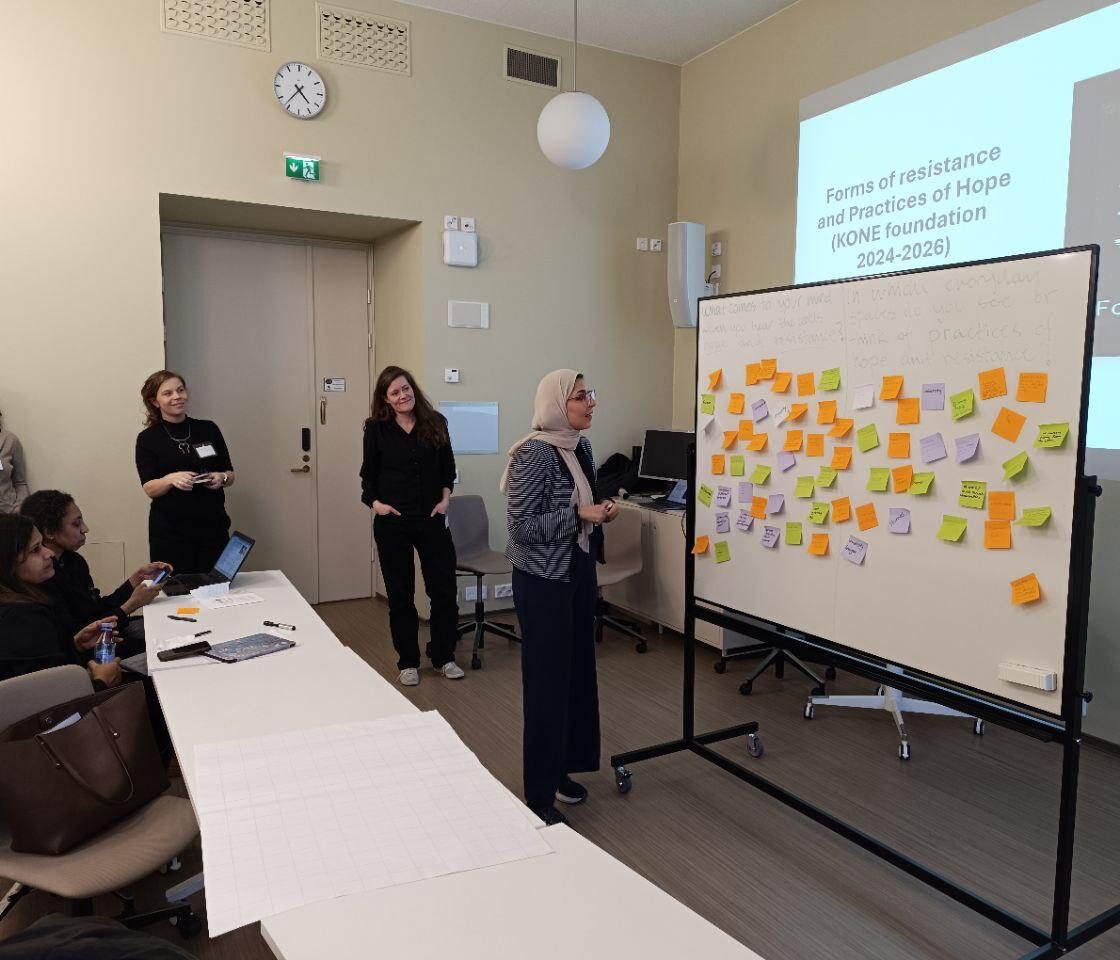
During the Development Days 2025 Conference, FoRE/HOPE organized an explorative workshop that invited participants to reflect on the concepts of hope and resistance as a source of knowledge. The workshop also explored their potential to challenge excluding oppressive and exploitative structures, as well as situations of violence, wars and discrimination.
The aim of this first workshop was to scope out participants’ understanding of hope, resistance and the potential and characteristics they imbued them with. It also sought to examine how participants understand the relationship between the concepts. Hope and resistance are deeply ambiguous concepts and experiences, and their relationship therefore also understood differently. This was also reflected in the workshop.
We began by asking participants what gives them hope. The answers were diverse and inspiring, reflecting the unique perspectives of each individual. Some participants found hope in people who stick with their values, while others were uplifted by encounters with other people. One poignant thought shared was, “you can do acts of hope, even if you are not hopeful,” highlighting the power of action in fostering hope, but also, interestingly, the transformative potential residing, even in the loss of hope. Nature also played a significant role, with mentions of the forest and music as sources of solace and inspiration. Additionally, many found hope in training and educating future generations, emphasizing the importance of investing in students and the future. It was evident that sources of hope varied widely, ranging from personal and communal to political and non-political. Participants drew hope from small acts of kindness as well as more structural efforts in education to alleviate or manage discrimination.
The workshop continued by reflecting on the following two questions: What comes to your mind when you hear the words ‘hope’ and ‘resistance’? In which everyday spaces do you imagine/see practices of hope and resistance? We intentionally asked people to reflect on both concepts together, to get a sense of how they intersect in people’s minds. For the first question, participants mentioned change and action, imagining different futures, stability, solidarity, liberation movements, not giving up, people standing their ground, encounters, small children, homeland, freedom, poetry and possibilities. In the second part of the exercise, they located hope and resistance in diverse spaces, including streets, political demonstrations, universities, homes, forests, family, crosscuts/shortcuts, dining table discussions, workplaces and research communities, libraries, everyday spaces of survival, and ‘while driving’.
These answers suggest that hope and resistance are woven into complex interactions between human-to-human relationships, objects, individual emotions and larger communal practices. They also locate hope and resistance in very different spaces, both formal and informal as well as part of both temporally disrupted and more continuous processes.
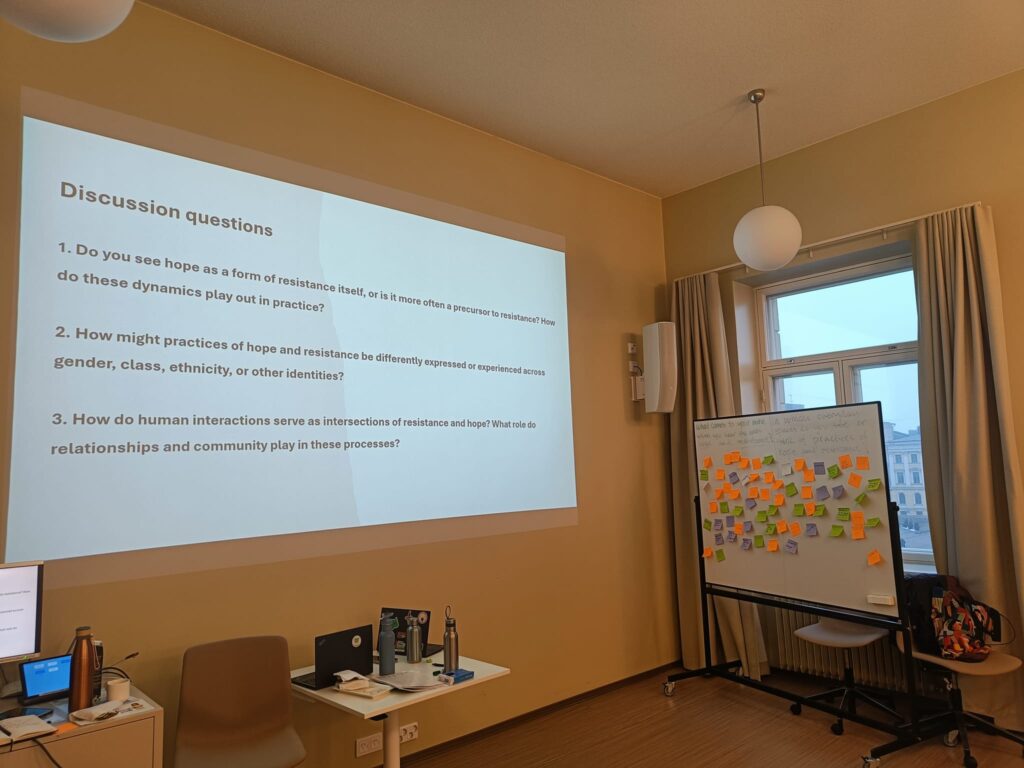
In the last activity, people rotated in groups to discuss three questions that focused on the relationships between hope and resistance. This was interesting because the tensions involved in working with these concepts came out in the discussions. For instance, some participants reflected on how resistance could romanticize everyday actions as resistance, making subconscious mundane acts into politicized forms of resistance. Conversely, others saw everyday practices of resistance as a way to highlight agency and potential for political change in small acts, in turn fueling hope. Hope itself was also contested, in particular when it came to discussing whether hope itself is political, and driving resistance, or merely a more ‘passive’ emotion that can sometimes hinder resistance through the passive act of hoping for a better future, rather than working for one.
In one group, the focus was on how human interaction played a role in resistance and hope. They highlighted shared understandings of the world, community building and making, (un)shared responsibility and agency. At the same time, they emphasized tensions, frictions, power struggles and margins. Reflecting on these answers, we discussed how the very ambiguities embedded in hope and resistance make their investigation as combined phenomena even more interesting.
Our second workshop, in 2026, built on the experiences of the first. This time we wanted to explore a specific exercise in the context of un-ness, namely how imagining a better world, or utopias, could fuel/disrupt/impede, intersections of hope and resistance. The theme of the 2026 conference, Development in ruins, hope in the cracks, can in itself be seen as a testament to the (un)settling feelings of disillusionment with global challenges and their solutions, circulating among people working with these issues. This also prompts reflections on hope and, importantly, the loss of hope and resistance in these contexts. How can utopias nurture hope and resistance, if at all?
We shaped the workshop around this central question. Participants were first asked to individually answer questions about their own utopias, what they contained, what they did not entail, what kinds of problems they wanted to have alleviated in them. We then worked in groups to combine individual visions into joint utopia(s). In the end, each group had to fill out their ideas by completing the sentence “We live in utopia when…”.
The workshop was informed by two interlocking starting points. First, seeing hope as political practice (see also Lindroth and Sinevaara 2020), and understanding it not as passive optimism, but as a collective, political force co-constructed through everyday practices, organized resistance, and efforts toward social change. Second, approaching utopias as tangible political agency (Boulding 2000). This rests on the idea that imagining positive futures is not (merely) wishful thinking. Rather, they can expand what is thinkable, challenge dominant narratives, and make alternative realities imaginable and therefore possible. As Boulding puts it, if we cannot imagine a better world, we do not know how to work towards one.
The workshop showed how difficult these starting points can be to implement in practice. Participants found it difficult to imagine a better world, without attaching notions of naivete or pointlessness to it. This ambivalence was also reflected in some of the perceptions of hope encountered in the first workshop. In addition, discussions noted how people’s different utopias are not always compatible, invoking problems of how to co-create a utopia that does not impede other utopias. These tensions exposed the inherent challenges in collective utopia-making. It was also not generally agreed by participants that the exercise itself, writing down what could be, had merit for actual, tangible change in the world.
The utopia exercises did initiate important reflections on what living in a better world means, individually and in community, but also revealed the difficulty with imagining that which does not (yet) exist. The difficulty with the exercise, for one team member at least, also reflected a broader issue of loss of hope. If the ability to hope for a better future, arguably deeply tied to the imagining of utopias, is political agency, what happens to that agency if we do not exercise it? It seemed difficult to look beyond the hopelessness of current global challenges, like trying to use an old muscle that had been inactive for too long. Building on theoretical perspectives on resistance that argue that we can understand resistance and the shape it takes, through analyzing that which it is resisting, this raises a further question: To understand how we change systems of oppression, do we also need to practice envisioning worlds without them, analyzing their social and political structures and the ways they are built?
The two workshops showed that hope and resistance form uneasy and complex relationships while their entanglements are impossible to ignore. Hope, for instance, is not a stable or fixed component of resistance. Sometimes hopelessness or survival drive resistance, sometimes hope is vital for initiating forms of resistance. While participants identified many everyday practices through which hope and resistance take shape, they also highlighted how difficult it is to cultivate and sustain hope in contexts of uncertainty and disillusionment. Rather than coherent utopias, what emerged were fragments, tensions, and hesitant attempts to imagine otherwise and that which is not yet there.
Investigating hope and resistance together however, can deepen understandings of the dynamics of social change, by highlighting the uneven and disrupted ways hope manifest in forms of resistance, including the loss or absence of hope. In exploring the relationships between hope, utopia and resistance, the workshops also sparked important reflections on whether and how hope as a form of political agency, can be practiced in the context of resistance and social change. Ultimately, the workshops invited us to continue untangling how to practice hope in the future not as a certainty but as a fragile and at the same time collective effort to envision alternatives. Despite the tensions, these practives may hold potential to reshape how we understand the future, how we resist and how we pursue social change and justice.
References
Agyei, P. D., & Iglesias Ortiz, A. (2025). Resistance and Hope in Balance: Toward a Complementary Conceptual Framework. Journal of Immigrant & Refugee Studies, 1–13. https://doi.org/10.1080/15562948.2025.2606199
Boulding, E. (2000). Cultures of Peace: The Hidden Side of History. Syracuse University Press
Lindroth, M. & Sinevaara-Niskanen, H. (2020). Politics of hope: Transformation or stagnation? In The Routledge Handbook of Transformative Global Studies (1st ed., pp. 231–243). Routledge. https://doi.org/10.4324/9780429470325-17